


How to Test Malolactic Fermentation in Wine with a TLC Kit
Quick answer: to check if malolactic fermentation (MLF) is finished, run a paper or thin layer chromatography (TLC) test. Spot your wine next to malic acid and lactic acid standards, let the solvent carry the acids up the sheet, then dry it. When the malic acid spot has gone and a lactic acid spot has appeared, MLF is complete. One sheet can test several wines at once, and the result is ready in a few hours.
This guide explains what MLF is, the three ways to test it, how to run a TLC test step by step, and how to read the spots on your sheet.
What is malolactic fermentation?
Malolactic fermentation is a second, bacterial fermentation that usually follows the alcoholic (yeast) fermentation. Lactic acid bacteria, most often Oenococcus oeni, convert sharp-tasting malic acid into softer lactic acid and a small amount of carbon dioxide.
- Why winemakers want it: MLF lowers the acidity, softens the taste and adds a rounder mouthfeel. Most red wines and many Chardonnays go through MLF.
- Why you must test it: if malic acid is still in the wine at bottling, bacteria can restart MLF in the bottle. That causes fizz, cloudiness, off-flavours and pushed corks.
- When to test: start a few weeks after adding the bacteria, then test every 1–2 weeks until the malic acid has gone. Test once more before you add sulphur dioxide (SO₂) and bottle.
3 ways to test malolactic fermentation
| Method | What it tells you | Time | Best for |
|---|---|---|---|
| Paper or TLC chromatography | Shows which acids are present (malic, lactic, tartaric, citric) as spots. Qualitative: yes or no, not an exact number. | A few hours, including drying | Home and small wineries testing several wines at once at low cost per test |
| Enzymatic malic acid test strips or kits | Gives an approximate malic acid level in g/L or mg/L. | Minutes | A quick check of one or two wines, or a final number before bottling |
| Laboratory enzymatic analysis | Accurate malic acid concentration, measured with a spectrophotometer. | Same day to a few days | Commercial wineries and export wines |
Chromatography is the classic method used by Australian winemakers. The Australian Wine Research Institute (AWRI) lists two qualitative versions:
- Paper chromatography: chromatography paper with a solvent of butanol, formic acid and water containing bromocresol green indicator.
- Thin layer chromatography (TLC): TLC sheets with a solvent of glacial acetic acid, isobutyl acetate and water, plus a bromocresol green indicator solution. TLC works the same way as paper but is much faster.
What you need for a TLC malolactic test
The ANPROS Thin Layer Chromatography (TLC) Test Kit includes the equipment and standards needed to run the test:
| Item in the kit | What it is for |
|---|---|
| Screw top square jar, 250 mL | Developing tank for the TLC sheet |
| TLC sheet, 200 × 200 mm (Macherey-Nagel) | The surface the acids separate on |
| TLC capillary tubes (100 per vial) | Spotting small, even drops of wine and standards |
| TLC standard malic acid and lactic acid (25 mL, 2 g/L) | Reference spots to compare your wine against |
| Measuring cylinder (10 mL), 4 squat beakers (100 mL), filter funnel | Measuring and handling solvent and samples |
| Stainless steel tweezers, large spring clip | Handling and holding the sheet without touching it |
| HB pencil, 30 cm ruler, A4 paper | Marking the start line and recording results |
You will also need TLC solvent mixture and TLC indicator. Refills of single TLC sheets, a box of 25 sheets, capillary tubes, malic acid standard and lactic acid standard are sold separately.
How to test malolactic fermentation with TLC: step by step
- Prepare the tank. Pour the solvent into the jar to a depth of about 1 cm, close the lid and let the air inside saturate for a few minutes. The solvent gives off strong vapours, so work in a fume cupboard or a well-ventilated area and wear gloves and safety glasses.
- Mark the start line. Hold the sheet by its edges. With the HB pencil (never a pen, as ink runs), draw a light line about 2 cm from the bottom. Mark a small dot for each sample about 2 cm apart, and label them underneath: M (malic), L (lactic), then your wines.
- Spot the samples. Dip a clean capillary tube in the malic standard and touch it to its dot, keeping the spot small (3–5 mm). Let it dry, then spot again 3–4 times on the same dot. Repeat with the lactic standard and each wine, using a new tube each time.
- Develop the sheet. Place the sheet in the jar with the spots at the bottom. The solvent must sit below the start line. Close the lid and leave the solvent to climb the sheet undisturbed.
- Stop the run. When the solvent is about 1–2 cm from the top, remove the sheet with tweezers and mark the solvent front with pencil.
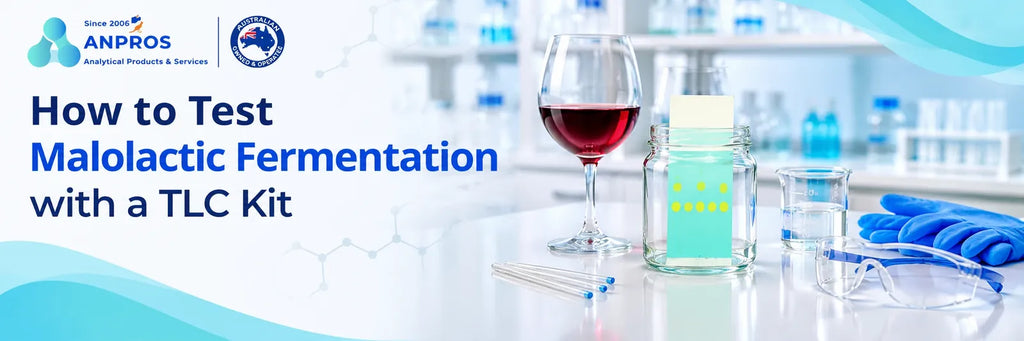
- Dry and develop the colour. Hang or lay the sheet in a ventilated area until the solvent has evaporated. Then apply the TLC indicator as directed with your kit. With a bromocresol green indicator, the acids show as yellow spots on a blue-green background.
Always follow the solvent volume, run time and safety instructions supplied with your kit and on the safety data sheets.
How to read your chromatography results
Each acid travels a different distance up the sheet. From the start line upwards, the usual order is:
| Position on the sheet | Acid | What it means |
|---|---|---|
| Lowest | Tartaric acid | Always present in grape wine. Not affected by MLF. |
| Low to middle | Citric acid | Small amounts are normal. Bacteria can use citric acid during MLF. |
| Middle | Malic acid | Still there = MLF not finished. |
| Higher, near the top | Lactic acid | Appears and grows as MLF progresses. |
Compare each wine with the malic and lactic standards on the same sheet:
- Strong malic spot, no lactic spot: MLF has not started.
- Malic and lactic spots both visible: MLF is in progress. Test again in 1–2 weeks.
- No malic spot, clear lactic spot: MLF is complete.
Chromatography shows whether malic acid is present, not exactly how much. If a very faint malic spot is hard to judge, test again a week later or confirm with an enzymatic malic acid test before bottling.
Common mistakes that spoil a TLC result
- Spots too big: large spots smear into each other. Keep them small and build them up in layers.
- Solvent above the start line: the samples wash off into the solvent instead of climbing the sheet.
- Using a pen: ink separates and creates false spots. Use a pencil only.
- Touching the sheet: fingerprints can leave acid marks. Use tweezers and hold the edges.
- No standards on the sheet: without malic and lactic standards beside your wine, spots are easy to misread.
- Not drying long enough: the colour only shows clearly once the solvent has fully evaporated.
How long does malolactic fermentation take?
MLF usually takes a few weeks but can run for several months. It is slower in cold cellars, at low pH, with high alcohol, and when free SO₂ is high, because lactic acid bacteria are sensitive to sulphur dioxide. Keep SO₂ low until MLF has finished, then adjust it once the test shows the malic acid has gone.
How to avoid or stop malolactic fermentation
Some crisp white wines, such as Riesling and Sauvignon Blanc, are often made without MLF to keep their fresh acidity. Winemakers usually prevent it by adding SO₂ after alcoholic fermentation, keeping the wine cool, and filtering before bottling. A chromatography test is still useful here: it confirms that MLF has not started by accident.
Frequently asked questions
How do I tell if malolactic fermentation is finished?
Run a paper or TLC chromatography test with malic and lactic acid standards. MLF is finished when the malic acid spot has disappeared and a lactic acid spot is visible.
How long does a TLC malolactic test take?
Spotting takes about 15 minutes. The solvent run and drying usually take a few hours, so many winemakers leave the sheet to dry overnight and read it the next morning.
Can I test several wines on one TLC sheet?
Yes. A 200 × 200 mm sheet fits the two standards plus several wine samples spaced about 2 cm apart, which keeps the cost per test low.
What does a yellow spot halfway up the sheet mean?
A spot level with your malic acid standard means malic acid is still in the wine and MLF is not complete. Compare its height with the standards on the same sheet.
Can I use a TLC kit for cider or fruit wine?
Yes. Apples and many fruits are high in malic acid, so the same method shows whether MLF has happened in cider and fruit wines. There will be no tartaric acid spot unless the juice contains grapes or added tartaric acid.
Where can I buy a malolactic chromatography test kit in Australia?
ANPROS in Boronia, Victoria supplies the TLC test kit, solvent, indicator, sheets, capillary tubes and malic and lactic standards, with delivery across Australia. See all our wine testing kits.
Related post
RECENT POSTS