


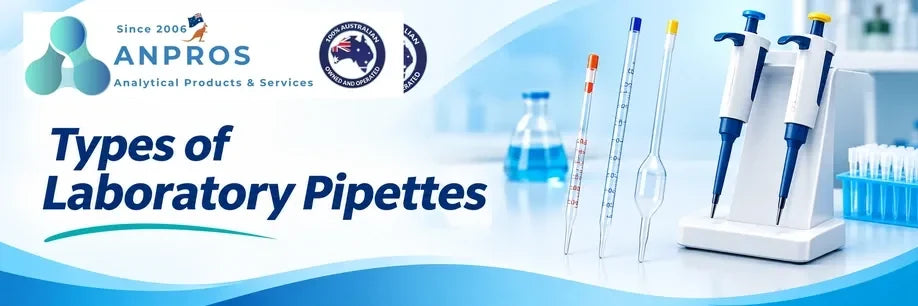
Types of Laboratory Pipettes: Volumetric, Graduated, Pasteur & Transfer
Quick answer: the four main types of laboratory pipettes are volumetric (bulb) pipettes, which deliver one fixed volume with the highest accuracy; graduated pipettes, which measure any volume along a scale; Pasteur pipettes, which move small amounts of liquid drop by drop without measuring; and plastic transfer pipettes, which are disposable droppers for quick, low-accuracy transfers. Use a volumetric pipette when the exact volume matters, such as in a titration, and a graduated pipette when you need different volumes from one tool.
This guide compares the four types, explains Class A and Class B, shows how to use a glass pipette correctly, and helps you choose the right pipette and pipette filler for your lab, school or winery.
Types of pipettes at a glance
| Type | What it does | Accuracy | Typical sizes | Best for |
|---|---|---|---|---|
| Volumetric (bulb) pipette | Delivers one fixed volume, marked by a single line above the bulb | Highest | 1 mL to 100 mL | Titrations, preparing standards and dilutions |
| Graduated pipette | Measures any volume up to its capacity using a printed scale | High (slightly lower than volumetric) | 0.1 mL to 100 mL | Adding different volumes of reagents with one tool |
| Pasteur pipette | Transfers liquid drop by drop; no scale | Not for measuring | Glass, about 150–230 mm long | Adding indicator drops, moving small samples, spotting |
| Plastic transfer pipette | Squeeze-bulb dropper, often with rough graduations | Approximate only | About 1 mL to 3.5 mL | Quick transfers, sampling, single use to avoid contamination |
Volumetric pipettes (bulb pipettes)
A volumetric pipette has a large bulb in the middle, a long narrow stem above it, and one calibration mark. It is made to deliver one exact volume, for example 10.00 mL, and nothing else.
- Most accurate pipette: the single mark sits on the narrow stem, so a small reading error changes the volume very little.
- Tolerances: ASTM E969 sets Class A volumetric pipette tolerances by size, for example ±0.006 mL for a 0.5 mL pipette and ±0.05 mL for a 50 mL pipette. Class B pipettes are allowed twice the Class A tolerance (source).
- Use it for: measuring a sample for titration, making standard solutions and accurate dilutions.
ANPROS supplies volumetric bulb pipettes from 1 mL to 100 mL in Class A and Class B.
Graduated pipettes (measuring pipettes)
A graduated pipette is a straight glass tube with a scale along its length, so you can measure any volume up to its capacity. A 10 mL graduated pipette can deliver 2.5 mL, 6.3 mL or the full 10 mL.
- Mohr and serological types: in a Mohr pipette the scale stops above the tip, and you drain between two marks. In a serological pipette the scale runs to the tip, and the last drop is blown out (source).
- Accuracy: slightly lower than a volumetric pipette of the same size, because the scale sits on a wider tube. Class B graduated pipettes are allowed twice the error of Class A.
- Use it for: adding different volumes of reagents, buffers or indicator solutions in one session.
ANPROS graduated pipettes are available from 0.1 mL to 100 mL in Class A and Class B.
Pasteur pipettes
A Pasteur pipette is a simple glass tube drawn out to a fine tip, used with a rubber teat. It has no scale, so it is not for measuring. It is ideal for adding a few drops of indicator, moving small amounts of liquid, or taking a sample from the top of a tube.
ANPROS stocks 228 mm glass Pasteur pipettes in packs of 10, 25 and 50.
Plastic transfer pipettes
Plastic transfer pipettes are one-piece droppers with a squeeze bulb. Some have rough graduations, but they are not accurate measuring tools. Because they are cheap and disposable, they are useful when you want to avoid cross-contamination between samples.
ANPROS plastic transfer pipettes come in 1 mL, 3 mL and 3.5 mL sizes, in packs of 50 or 100.
Class A vs Class B pipettes
| Class A | Class B | |
|---|---|---|
| Accuracy | Tightest tolerance | Up to twice the Class A tolerance |
| Best for | Analytical work, standards, quality control, accredited labs | Teaching labs, routine work, general measuring |
| Cost | Higher | Lower |
If your result goes into a report, a specification or a calculation such as titratable acidity, choose Class A. For school practicals and routine checks, Class B is usually enough.
Pipette vs burette vs measuring cylinder
| Tool | Job | Accuracy |
|---|---|---|
| Volumetric pipette | Delivers one fixed volume of sample | Highest |
| Burette | Adds a variable volume of titrant, drop by drop, during a titration | High |
| Measuring cylinder | Measures approximate volumes quickly | Lower |
In a typical acid–base titration, the sample is measured with a volumetric pipette, the titrant is added from a burette, and an indicator such as phenolphthalein shows the end point. Our pH indicator chart helps you choose the right indicator.
How to use a glass pipette correctly
- Never pipette by mouth. Always use a 3-valve pipette filler or a pipette bulb.
- Check the pipette. Make sure it is clean, dry or rinsed, and the tip is not chipped. A chipped tip changes the volume delivered.
- Rinse with the solution. Draw up a small amount of the liquid you will measure, tilt and turn the pipette to wet the inside, then discard it. Repeat two or three times.
- Fill above the mark. Draw the liquid a little above the calibration mark.
- Set the meniscus. Hold the pipette upright with the mark at eye level. Let liquid run out slowly until the bottom of the meniscus sits exactly on the mark.
- Wipe the outside of the tip with a clean tissue, without touching the opening.
- Deliver. Hold the tip against the inside wall of the receiving flask and let the liquid drain freely.
- Do not blow out the last drop from a volumetric pipette marked "TD" (to deliver), unless it is marked for blow-out. The small amount left in the tip is allowed for in the calibration.
- Clean straight after use. Rinse with water, then distilled water. A pipette brush helps remove residue from narrow glassware.
Common pipetting mistakes
- Reading the meniscus from above or below: always read at eye level, or the volume will be wrong.
- Air bubbles in the stem: refill if you see bubbles, as they take up volume.
- Not rinsing with the solution: leftover water dilutes the sample.
- Using a graduated pipette when one exact volume is needed: a volumetric pipette is more accurate for a single fixed volume.
- Using a dirty pipette: grease or residue makes drops cling to the glass and changes the volume delivered.
How to choose the right pipette
| If you need to… | Choose |
|---|---|
| Measure one exact volume for a titration or standard | Volumetric pipette, Class A |
| Add several different volumes with one tool | Graduated pipette |
| Add a few drops of indicator or reagent | Pasteur pipette |
| Move samples quickly without cross-contamination | Plastic transfer pipette |
| Fill any glass pipette safely | Pipette filler or bulb |
Winemakers testing titratable acidity, for example, measure the wine sample with a volumetric pipette and titrate with sodium hydroxide from a burette. ANPROS also supplies complete kits such as the Titratable Acidity (TA) Test Kit.
Frequently asked questions
What is the most accurate type of pipette?
A Class A volumetric (bulb) pipette. It delivers one fixed volume with the tightest tolerance, for example ±0.05 mL for a 50 mL pipette under ASTM E969.
What is the difference between a graduated and a volumetric pipette?
A volumetric pipette has one mark and delivers one exact volume. A graduated pipette has a scale and can deliver any volume up to its capacity, with slightly lower accuracy.
What is the difference between Class A and Class B pipettes?
Class A pipettes have the tightest tolerance. Class B pipettes are allowed up to twice the Class A tolerance and cost less, so they suit teaching and routine work.
Should you blow out the last drop of a pipette?
Not from a volumetric pipette marked "TD" (to deliver); the drop left in the tip is part of the calibration. Serological graduated pipettes made for blow-out are emptied completely.
What is a Pasteur pipette used for?
Moving small amounts of liquid or adding drops of indicator or reagent. It has no scale, so it is not used for measuring volumes.
Where can I buy laboratory pipettes in Australia?
ANPROS in Boronia, Victoria supplies volumetric and graduated glass pipettes in Class A and Class B, Pasteur pipettes, plastic transfer pipettes, pipette fillers and pipette brushes, with delivery across Australia.
Related post
RECENT POSTS