

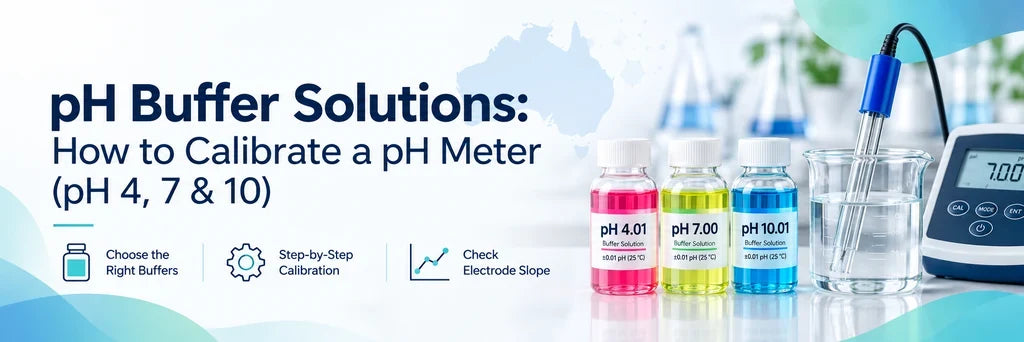
pH Buffer Solutions: How to Calibrate a pH Meter (pH 4, 7 & 10)
Quick answer: To calibrate a pH meter, rinse the electrode with distilled water, place it in pH 7.00 buffer first, then calibrate with pH 4.00 (for acidic samples) or pH 10.00 (for alkaline samples). Rinse between each buffer, use fresh buffer every time, and check that the meter's slope is about 95–105%. For samples across a wide pH range, use all three buffers.
A pH meter is only as accurate as its last calibration. Whether you test wine, water, food or laboratory samples, calibrating with fresh pH buffer solutions is what turns a reading into a result you can trust. This guide explains which pH buffer solutions to use, how to calibrate a pH meter step by step, how to check your calibration and how to look after your electrode.
What is a pH buffer solution?
A pH buffer solution is a liquid with a known, stable pH value that resists change when small amounts of acid or base are added. Because its pH is known, it gives your pH meter a reference point. During calibration, the meter measures the buffer and adjusts itself so its reading matches the buffer's stated value.
Buffers used for calibration are also called pH calibration solutions, pH calibration buffers or pH standard buffer solutions. The most common values are pH 4.00, pH 7.00 and pH 10.00.
Which pH buffer solutions do you need?
Most pH meters are calibrated with two or three buffers. Choose buffers that cover the pH range of the samples you test.
| Buffer | Role in calibration | Best for |
|---|---|---|
| pH 7.00 buffer | Neutral point (offset). Usually calibrated first. | Every calibration |
| pH 4.00 buffer | Sets the slope on the acidic side. | Wine, juice, food and other acidic samples |
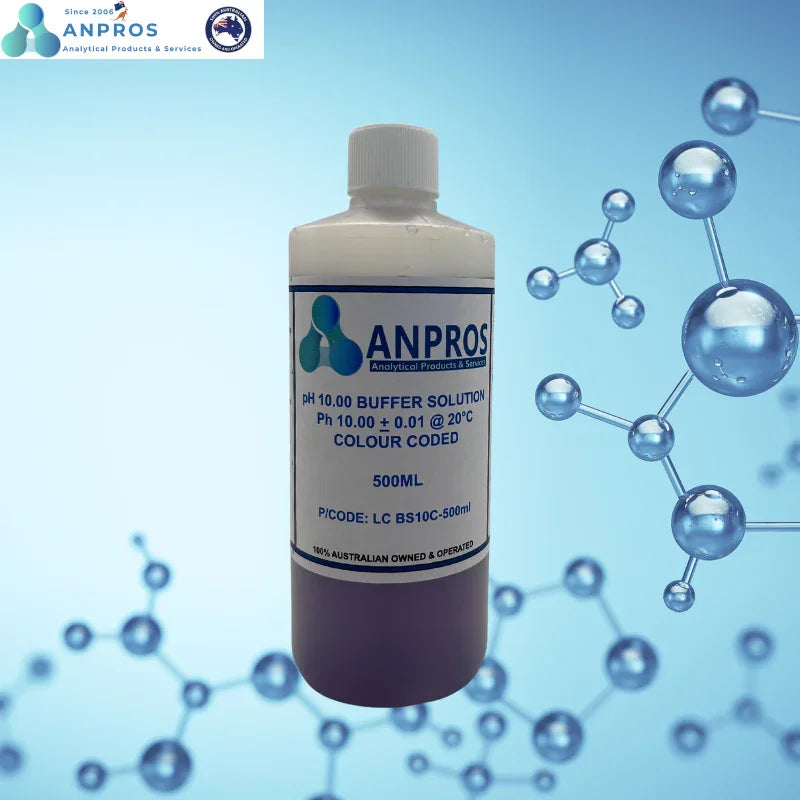
| pH 10.00 buffer | Sets the slope on the alkaline side. | Alkaline samples, cleaning solutions, some water testing |
| pH 6.88 buffer | Alternative neutral point. | Meters and methods that use a buffer group with a neutral point below 7.00 |
Two-point or three-point calibration?
| Calibration | Buffers | When to use it |
|---|---|---|
| One-point | pH 7.00 | Quick offset check only. Not recommended for accurate work. |
| Two-point | pH 7.00 + pH 4.00, or pH 7.00 + pH 10.00 | Most routine testing, when samples sit between the two buffers |
| Three-point | pH 4.00 + 7.00 + 10.00 | Samples across a wide pH range, or when you need the highest accuracy across the scale |
pH 7.00 or 6.86/6.88? Understanding buffer sets
Many pH meters recognise buffers automatically and are set up for one buffer group. The two most common groups are:
- pH 4.01, 7.00 and 10.01: the most widely used set for everyday calibration.
- pH 4.01, 6.86 and 9.18: a set based on standard phosphate and borax buffers, used by some meters and laboratory methods.
Check your meter's manual and use the buffers that match its group. Don't mix buffer sets in the same calibration.
Colour-coded or colourless buffers?
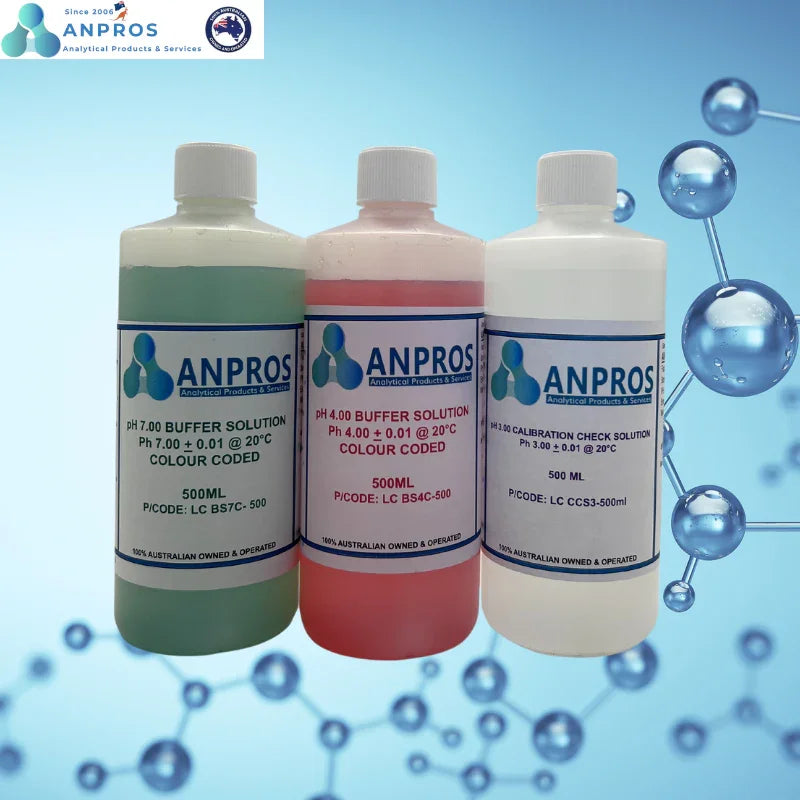
ANPROS supplies pH 4.00 and pH 7.00 buffers in both colour-coded and colourless forms. Colour-coded buffers make it easy to tell bottles and beakers apart, which helps prevent mix-ups at the bench. Some analysts prefer colourless buffers because they believe dyes may affect the pH electrode. Both work for calibration, so choose what suits your lab's routine.
How to calibrate a pH meter: step by step
- Check your buffers. Use buffers within their expiry date. Pour a small amount of each into a clean beaker. Never dip the electrode into the stock bottle, and never pour used buffer back.
- Bring everything to the same temperature. Buffer pH values change with temperature, and most bottles list the value at different temperatures. If your meter has automatic temperature compensation (ATC), connect the temperature probe.
- Prepare the electrode. Remove the storage cap, rinse the electrode with distilled water and gently blot it with a lint-free tissue. Blot, don't wipe: wiping can build up static charge on the glass and cause unstable readings.
- Calibrate pH 7.00 first. Place the electrode in pH 7.00 buffer, stir gently, wait until the reading is stable (often up to a minute or two) and confirm the point on your meter.
- Rinse between buffers. Rinse with distilled water and blot dry every time you move to a new buffer, so one buffer doesn't contaminate the next.
- Calibrate the second buffer. Use pH 4.00 for acidic samples or pH 10.00 for alkaline samples. Wait for a stable reading and confirm.
- Add a third buffer if needed. For a three-point calibration, repeat with the remaining buffer.
- Check slope and offset. Most meters show the electrode slope after calibration. As a general guide, a slope of about 95–105% indicates a healthy electrode. If your meter shows an error or the slope is outside the manufacturer's limits, clean the electrode and calibrate again.
- Discard the used buffer and return the electrode to its storage solution, or start measuring.
How to check your pH meter calibration
A calibration check confirms your meter reads correctly. Measure a solution of known pH, without calibrating, and compare the reading with its stated value.
This is especially useful when your samples sit outside your calibration buffers. A pH 3.00 calibration check solution confirms accuracy at the low end of the scale. ANPROS also offers a calibration check set of 3 x 500 mL (pH 4.00, 7.00 and 3.00).
Calibrating a pH meter for wine and grape juice
Wine and grape juice are acidic, typically around pH 3 to 4, so winemakers calibrate with pH 7.00 and pH 4.00 buffers and then check accuracy with a pH 3.00 check solution.
- The Australian Wine Research Institute (AWRI) advises calibrating the pH meter with standard buffer solutions daily, or as the manufacturer instructs.
- The AWRI also advises degassing wine samples before measuring, to remove dissolved carbon dioxide, and correcting for temperature.
- Wine and juice leave protein and residue on the electrode. Clean it regularly with an anti-protein pH electrode cleaning solution.
For other wine tests, see the ANPROS range of wine testing kits.
How often should you calibrate a pH meter?
| How you use the meter | Typical calibration |
|---|---|
| Laboratory, quality control or regulated testing | Daily, or before each testing session |
| Routine process or field testing | At least weekly, and whenever readings seem off |
| Occasional, non-critical use | Before each use |
Calibrate more often if you test many samples, dirty or high-protein samples, or samples at very different temperatures. Always follow the method or standard your lab works to.
pH meter calibration troubleshooting
| Problem | Likely cause | What to do |
|---|---|---|
| Meter won't accept calibration | Old or contaminated buffer, wrong buffer group, dirty electrode | Use fresh buffer that matches the meter's group, then clean the electrode |
| Readings drift | Dirty or dry electrode, temperature difference, static from wiping | Clean the electrode, match temperatures, blot instead of wiping |
| Slow response | Coated or ageing electrode | Clean with electrode cleaning solution; replace the electrode if it doesn't improve |
| Slope outside 95–105% | Electrode wear or contamination | Clean and recalibrate; if the slope stays low, the electrode may need replacing |
How to look after your pH electrode
- Keep it moist. Store the electrode in pH electrode storage solution, a buffered KCl solution that keeps the glass hydrated and stops it becoming dry and brittle. Don't store the electrode in distilled water.
- Clean it regularly. ANPROS electrode cleaning solution comes in general-use and anti-protein types, to remove build-up and restore response.
- Rinse after every sample with distilled water, and blot dry.
How to store pH buffer solutions
- Keep bottles tightly closed. Alkaline buffers such as pH 10.00 absorb carbon dioxide from the air, which lowers their pH over time.
- Store away from direct sunlight and heat.
- Write the opening date on each bottle. Buffers typically last much longer sealed than opened, so always follow the expiry date on the bottle and replace any buffer that looks cloudy or contaminated.
- Choose a pack size that suits how often you calibrate. ANPROS buffers come in 500 mL, 1 L and 2.5 L bottles.
pH meter, test strips or indicator solution?
A calibrated pH meter gives the most precise result. For a quick check where high precision isn't needed, PEHANON pH test strips or universal indicator solution (pH 4 to pH 11) are fast and simple.
Frequently asked questions
What pH buffer solutions do I need to calibrate a pH meter?
Most users need pH 7.00 plus pH 4.00 (for acidic samples) or pH 10.00 (for alkaline samples). Use all three for a three-point calibration across a wide pH range.
Which buffer do I calibrate first?
Calibrate pH 7.00 first, then pH 4.00 and/or pH 10.00, unless your meter's manual says otherwise.
Can I calibrate a pH meter with only one buffer?
A one-point calibration only corrects the offset, not the slope. Use at least two buffers for reliable results.
Can I reuse pH buffer solution?
No. Used buffer may be contaminated or may have absorbed carbon dioxide. Use fresh buffer for each calibration and never pour it back into the bottle.
What is the difference between pH 7.00 and pH 6.86 buffer?
They belong to different buffer sets. pH 7.00 is part of the 4.01, 7.00 and 10.01 set, and pH 6.86 is part of the 4.01, 6.86 and 9.18 set. Use the set your meter is programmed for.
What is a good slope for a pH electrode?
As a general guide, about 95–105%. A slope outside your meter manufacturer's limits usually means the electrode needs cleaning or replacing.
Why does my pH meter fail to calibrate?
Common causes are old or contaminated buffer, a dirty or dry electrode, a temperature difference between buffer and meter, the wrong buffer group or a worn-out electrode. Try fresh buffer and clean the electrode first.
Where can I buy pH buffer solutions in Australia?
ANPROS in Boronia, Victoria supplies pH 4.00, 6.88, 7.00 and 10.00 buffer solutions in 500 mL, 1 L and 2.5 L bottles, plus pH 3.00 check solution and electrode storage and cleaning solutions.
Buy pH buffer solutions in Australia
ANPROS supplies pH buffer solutions, calibration check solutions and pH electrode storage and cleaning solutions for laboratories, wineries and industry. Browse the full pH buffer, calibration and electrode maintenance range, or contact the ANPROS team for help choosing the right products.
Related post

04
Dec
28
Aug
RECENT POSTS
04.December.2025
The Foundation of Accuracy: Why Lab-Grade Glassware Detergent is Non-Negotiable – Supplied by Anpros
0 Comments