

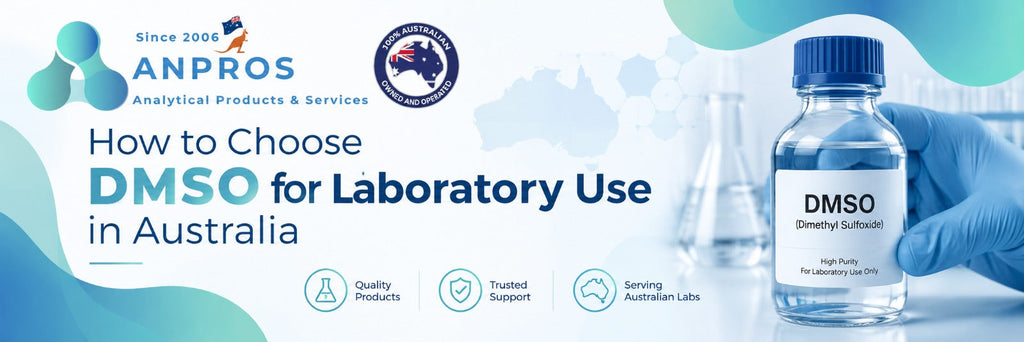
How to Choose DMSO for Laboratory Use in Australia
Dimethyl Sulfoxide, also abbreviated as DMSO, is an organic solvent with multiple applications in laboratory research, chemical reactions, and other scientific experiments. The solvent's solvating properties make it applicable in the preparation of solutions and the performance of various laboratory procedures. According to PubChem, the chemical name for DMSO is Dimethyl Sulfoxide, with CAS number 67 68 5 and molecular formula C2H6OS.
However, selection of a DMSO product for laboratories is not based solely on the purity and cost of the product. There are several considerations that laboratories should take into account when choosing which DMSO product to purchase, including the intended application, product grade, purity, pack size, storage needs, and documentation.
For laboratories in Australia, knowledge of the above factors can help them easily choose a suitable DMSO product for a particular laboratory procedure.
This article will help you understand what DMSO is, what it is used for in laboratories, the considerations for selecting DMSO products, and how to evaluate DMSO suppliers in Australia.
What Is DMSO
DMSO is short for Dimethyl Sulfoxide. DMSO is a sulfur based organic compound and also a polar solvent.
It is known for having very good solvating properties and dissolving a wide range of other compounds. Additionally, it is miscible with water and therefore can be quite helpful in preparing solutions where both organic substances and water are involved.
The compound's CAS registry number is 67 68 5, and it has a molecular weight of 78.14 g/mol.
If you need additional laboratory chemicals, check out our ANPROS range of laboratory chemicals.
Why Is DMSO Used in Laboratories
DMSO is extensively used as a laboratory solvent because of its capability to dissolve a wide variety of compounds. This helps where scientists require solutions to be made using compounds that might not be soluble in other types of solvents.
DMSO can be used as a solvent and a reaction medium during chemical investigations. The suitable product specification will vary according to the process involved.
For laboratories that require different types of solvents, ANPROS also provides a range of laboratory solvents.
What Should You Consider When Choosing DMSO
There is no universal DMSO that will be appropriate for all laboratory purposes. The suitability of DMSO will depend on what purpose it will serve.
The following considerations should be borne in mind before buying DMSO.
Intended Application
Begin by determining the use of DMSO.
The requirements for a product that is intended for general laboratory use would differ from those of one intended for analytical or pharmaceutical use.
This will aid in establishing what grade or purity of DMSO to buy.
Purity
Purity is an important factor when selecting a laboratory solvent.
Applications that are sensitive to unwanted contaminants may require a higher purity product. However, laboratories should not select a product based only on the highest number shown on a label.
The required purity should be based on the procedure, specification, and intended application.
ANPROS currently lists DMSO Pure Pharma Grade 99.99%, with available pack sizes ranging from 100 ml to 5 L.
Product Grade
DMSO can be supplied with different specifications for different applications.
When choosing a product, check whether the stated grade is appropriate for the intended laboratory procedure.
The grade should be considered together with purity, product specification, and available documentation.
Product Specification
A product specification provides more information than the product name alone.
Depending on the application, laboratories may need to review information such as purity, physical properties, storage conditions, and other product specific requirements.
This is particularly important when a laboratory has defined purchasing or quality requirements.
Pack Size
The amount of DMSO required should also be considered.
A lab that conducts research infrequently would favor a small pack size, whereas one that frequently or regularly conducts research might favor a bigger pack size.
The available pack sizes of DMSO Pure Pharma Grade 99.99% by ANPROS include 100 ml, 200 ml, 500 ml, 1 L, 2.5 L, and 5 L.
Selecting an appropriate pack size can be helpful for laboratories.
Is Higher Purity DMSO Always Better
Purity may be crucial in some cases, but this does not imply that higher purity is always the right thing to look for. Instead, the correct method would be to first consider what the needs of the particular application are.
Consider the following:
• Required purity
• Required grade
• Intended application
• Product specification
• Storage requirements
• Documentation
• Pack size
• Supplier support
For example, a routine laboratory process may have different requirements from a specialised research procedure.
The correct DMSO should therefore be selected according to the laboratory's specific needs rather than simply choosing the product with the highest stated purity.
Why Does DMSO Purity Matter in Laboratory Work
Solvent quality can be important when a laboratory procedure requires consistent conditions.
Unwanted substances can potentially affect sensitive procedures, depending on the application. This is why laboratories should review the product specification before purchasing a solvent.
High purity DMSO can be useful where a controlled solvent specification is required.
However, purity should always be evaluated alongside the intended use and product grade.
Laboratories should also follow the requirements of their own procedures and consult the manufacturer's product documentation and Safety Data Sheet before use.
How to Select the Right DMSO Pack Size
Choosing the correct pack size is a practical part of laboratory purchasing.
Small quantities can be useful for laboratories with occasional requirements. Larger containers may be more appropriate when DMSO is used regularly or in higher volumes.
The choice should take into account:
• Expected consumption
• Frequency of use
• Storage capacity
• Product shelf life requirements
• Purchasing frequency
• Handling requirements
ANPROS provides multiple DMSO pack sizes, giving laboratories the option to select a quantity according to their requirements.
DMSO Storage and Handling
Correct storage and handling are important when working with laboratory chemicals.
DMSO should be stored according to the manufacturer's product documentation and Safety Data Sheet. The container should be kept properly closed when the product is not being used.
DMSO may crystallize at temperatures close to room temperature.
When handling DMSO, laboratories should:
• Follow the manufacturer's Safety Data Sheet.
• Use appropriate personal protective equipment.
• Avoid unnecessary contact with the eyes and skin.
• Keep the container properly closed.
• Follow established laboratory handling procedures.
• Maintain suitable storage conditions.
• Keep the original product label and documentation available.
For laboratories that require protective equipment, ANPROS also provides PPE kits.
What Documentation Should You Check Before Buying DMSO
Product documentation can help laboratories determine whether a chemical is appropriate for a particular application.
Before purchasing DMSO, consider checking:
• Product name
• Purity
• Grade
• Product specification
• Safety Data Sheet
• Storage information
• Handling requirements
• Available pack sizes
• Supplier information
Documentation is especially useful when laboratories have internal quality control or purchasing requirements.
ANPROS provides information about its quality control process and customer support.
How to Choose a DMSO Supplier in Australia
When searching for a DMSO supplier in Australia, price should not be the only factor.
A laboratory should look at the complete product offering and supplier information.
Before choosing a supplier, consider asking:
1. What DMSO grade is available?
2. What purity specification does the product meet?
3. What pack sizes are available?
4. Is product documentation available?
5. What storage conditions are recommended?
6. Does the supplier provide technical support?
7. Can the supplier provide other laboratory chemicals and reagents?
ANPROS currently supplies laboratory chemicals, solvents, reagents and other laboratory products through its Australian operation. Its laboratory product categories include laboratory chemicals, laboratory solvents, standard solutions and laboratory test solutions.
Customers can also review purchasing information before placing an order.
How to Choose a DMSO Supplier in Australia
When searching for a DMSO supplier in Australia, price should not be the only factor.
A laboratory should look at the complete product offering and supplier information.
Before choosing a supplier, consider asking:
1. What DMSO grade is available?
2. What purity specification does the product meet?
3. What pack sizes are available?
4. Is product documentation available?
5. What storage conditions are recommended?
6. Does the supplier provide technical support?
7. Can the supplier provide other laboratory chemicals and reagents?
ANPROS currently supplies laboratory chemicals, solvents, reagents and other laboratory products through its Australian operation. Its laboratory product categories include laboratory chemicals, laboratory solvents, standard solutions and laboratory test solutions.
Customers can also review purchasing information before placing an order.
What will the DMSO be used for?
Clearly identify the intended application.
What purity is required?
Check the laboratory procedure or applicable specification.
What grade is required?
Confirm that the product grade is suitable for the intended use.
How much DMSO is required?
Choose a pack size based on expected usage and available storage capacity.
What documentation is required?
Determine whether your laboratory needs product specifications, Safety Data Sheets or additional documentation.
DMSO and Other Laboratory Chemicals
DMSO may be only one part of a wider laboratory workflow.
Depending on the application, laboratories may also require reagents, standard solutions, measuring equipment, sample containers and laboratory glassware.
ANPROS provides laboratory standard solutions for laboratory and analytical requirements.
The company also supplies laboratory test solutions and reagents for different testing applications.
For measuring, mixing and handling laboratory solutions, suitable laboratory glassware and plastic ware may also be required.
Sourcing related laboratory products from one supplier can make purchasing and product selection more convenient.
Why Choose ANPROS for DMSO
ANPROS supplies laboratory chemicals and scientific products for customers in Australia.
Its current product range includes laboratory chemicals, solvents, reagents, standard solutions, laboratory glassware and other laboratory supplies.
For customers looking for high purity DMSO, ANPROS currently lists DMSO Pure Pharma Grade 99.99% in multiple pack sizes.
The company also provides product and purchasing information to help customers evaluate laboratory chemical requirements.
When selecting a supplier, laboratories should always compare the product specification with their own application requirements and review the relevant manufacturer documentation before use.
Conclusion
Selecting the correct DMSO for the laboratory involves much more than price or purity alone. The laboratory should determine its application first and then select the suitable grade of DMSO, purity, specifications, pack size, and storage.
High purity DMSO may have application in laboratory procedures that require a high grade of solvent. However, the chosen grade should always fit in with the application requirements.
ANPROS offers a wide range of laboratory chemicals, solvents, reagents, standard solutions and laboratory supplies including DMSO Pure Pharma Grade 99.99%, for laboratories interested in sourcing DMSO in Australia.
By selecting DMSO according to the actual laboratory requirement and purchasing from a supplier that provides clear product information and support, laboratories can make a more informed decision when sourcing DMSO.
For product information or purchasing assistance, customers can contact ANPROS.
Frequently Asked Questions About Choosing DMSO
What DMSO is best for laboratory use?
The appropriate DMSO depends on the laboratory application. Consider the required purity, grade, product specification, and documentation before selecting a product.
What purity of DMSO should I choose?
Purity is dictated by the particular process involved. For those applications that are vulnerable to impurities, the demand for purity will be much higher.
Is DMSO a good laboratory solvent?
DMSO is an extensively used laboratory solvent because it is capable of dissolving a wide range of substances and is soluble in water.
What should I check before buying DMSO?
Check the intended application, purity, grade, product specification, pack size, storage requirements, documentation and supplier information.
Where can I buy DMSO in Australia?
DMSO is available from laboratory chemical suppliers in Australia. When choosing a supplier, compare product specifications, available sizes, documentation and supplier support rather than price alone.
Does ANPROS supply high purity DMSO?
Yes. ANPROS currently lists DMSO Pure Pharma Grade 99.99% in multiple pack sizes.
How should DMSO be stored?
DMSO should be stored according to the manufacturer's current product documentation and Safety Data Sheet. The container should remain properly closed and protected from unsuitable storage conditions.
Related post

04
Dec
28
Aug
28
Aug
28
Aug
RECENT POSTS
04.December.2025
The Foundation of Accuracy: Why Lab-Grade Glassware Detergent is Non-Negotiable – Supplied by Anpros
0 Comments